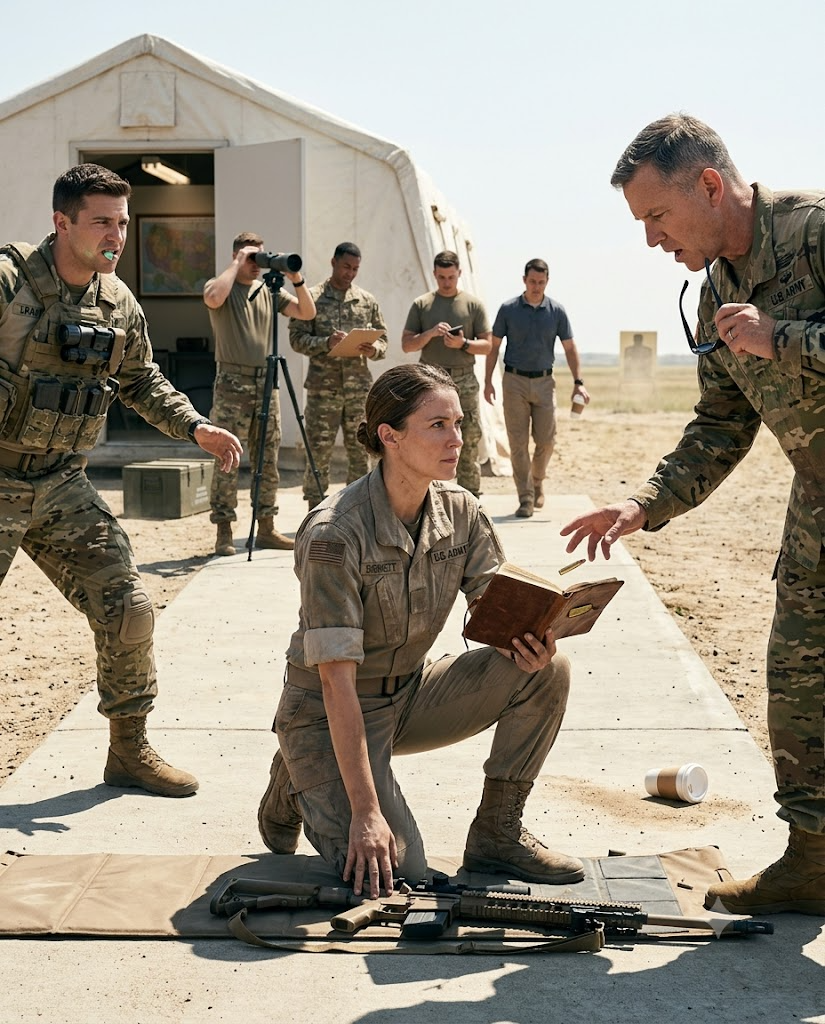
After thirteen male snipers missed an impossible target on a dry Army test range, Lieutenant Kravitz laughed at my plain logistics uniform. “Go back to the supply tent, Captain Bennett, or I’ll make sure you never leave the warehouse again.” I said nothing. I only set my old notebook on the concrete, and General Grant froze when he saw the call sign inside.
The test range went so quiet I could hear the heat ticking against the rifle barrels.
Thirteen men had stepped up to the line before me.
Thirteen decorated shooters.
Thirteen clean uniforms, expensive optics, squared shoulders, and voices that dropped lower every time the spotter said, “Miss.”
The target stood four thousand meters out, a pale square trembling in the shimmer over the flat brown field. At that distance, the world lies to you. Wind does not move in one direction. Heat lifts a target a finger higher than where it really sits. Gravity takes its time, but it never gives discounts.
The first sniper pulled left.
The second broke right.
By the eighth shot, nobody near the observation tower was joking anymore. By the thirteenth, everyone had stopped pretending the distance was the only problem.
General Michael Grant took off his dark glasses and looked down the firing line.
Nobody stepped forward.
I stood behind the logistics tent with an ammo inventory tablet under my arm, dust on my boots, and that warm copper taste in my mouth that always came when men decided I was furniture. To most of them, I was just Captain Sarah Bennett from supply. A few called me “coffee lady” when they thought I was too far away to hear.
Kravitz was the loudest.
That morning, he had laughed when I sorted an overturned crate of mixed rounds by weight, caliber, and manufacturer without checking the labels twice. He called it a parlor trick.
I called it a way to stay alive.
So when I asked permission to try, heads turned so fast you would have thought I had insulted not the men, but the idea of their confidence.
Kravitz walked close enough for me to smell mint gum and sun-baked arrogance. Then he gave me that threat about the warehouse.
I did not answer.
Sometimes silence weighs more than shouting.
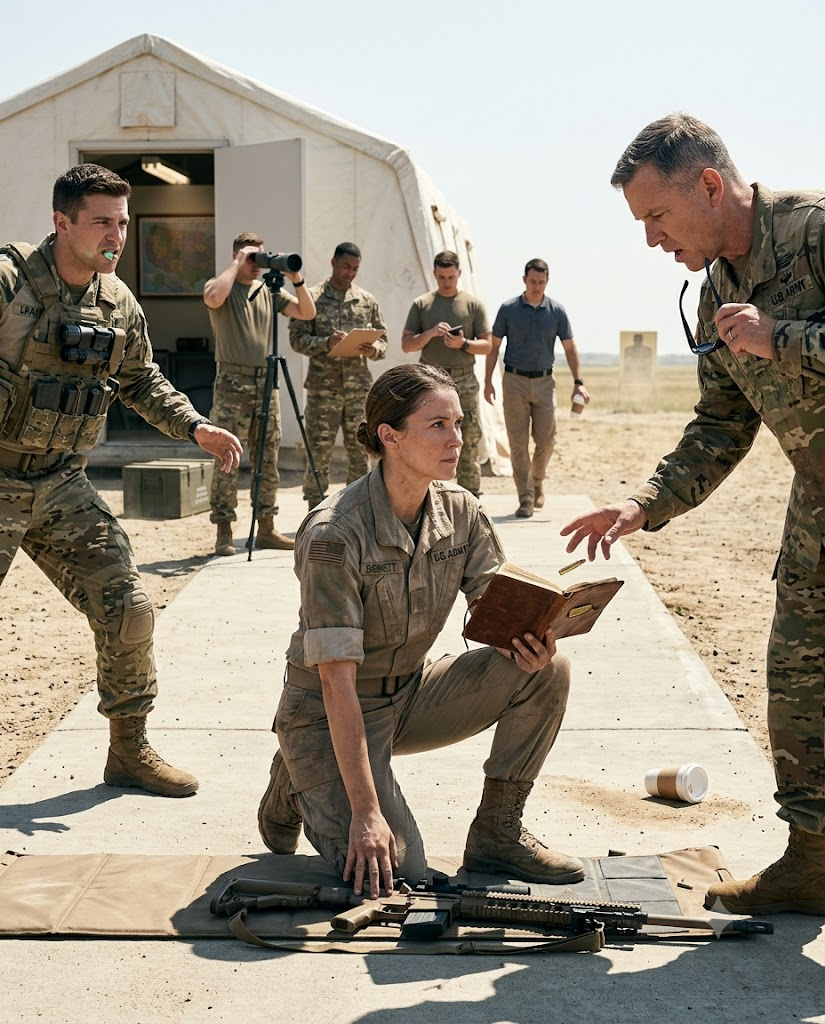
I walked to the shooting mat, pulled an old leather notebook from the thigh pocket of my cargo pants, and placed it on the concrete beside the rifle. The cover was cracked from sand, sweat, and one desert deployment nobody on that range had ever asked me about.
General Grant watched my hands.
Good commanders do that. They listen to the body before they trust the mouth.
Inside that notebook were wind tables, pressure marks, range sketches, correction angles, and one brass casing tucked into the back flap. A date was scratched into the metal from seven years ago. Beside it was a call sign carved so small most men would have mistaken it for damage.
I had not shown it to anyone in seven years.
Not because I was ashamed.
Because some rooms punish a woman for having a past before they ever ask what it cost her.
The rifle on the mat was not mine. Newer, heavier, cleaner, and far too pleased with itself. I checked the bolt, the stock, the balance, and let my palm learn the trigger.
Behind me, someone muttered that we were wasting range time.
I heard him.
I also heard the high wind marker above the tower twitch first, while the marker near the target moved half a second later. The upper layer of air was changing before the lower one.
That was what thirteen men had missed.
Not courage.
Not skill.
Timing.
I opened the notebook to a page written in graphite so old the corners of the numbers had blurred gray. General Grant stepped closer. His eyes dropped to the back flap.
And his face changed.
The hardness left his jaw. He looked at the brass casing, then at me, then back at the call sign, like some locked door in his memory had just opened.
Kravitz noticed.
His smile died halfway.
The whole range froze around us. One spotter kept his eye near the scope but stopped breathing through his nose. A sergeant by the ammo table lowered his clipboard without realizing it. Someone’s paper coffee cup tipped in the dust and rolled twice before stopping against a boot. Even the men who had laughed at me looked down at my notebook like it had become evidence.
Nobody moved.
The rifle waited in front of me.
The dry field waited beyond it.
I took one breath, looked through the shimmer, and said the only sentence I needed.
“Then let the math talk.”
The page lay open in the white sun. General Grant’s hand hovered an inch above the scratched call sign, and in the silence, he whispered…
Part 2 below 👇👇
Part 2: “Ghostline.”
The word came out of General Grant’s mouth so quietly that at first nobody understood why it made the air change.
But I did.
Kravitz’s face tightened. “Sir?”
Grant did not look at him. He kept staring at the casing tucked into the back of my notebook, at the date, at the tiny carved letters I had buried there seven years ago. His fingers curled once, like he had touched a live wire.
“You were on Ridge Seven,” he said.
A sound moved through the line, not a gasp exactly, but close. Every sniper there knew the story. They knew a shot had been taken in bad wind, under dead radio, when no official shooter could get a clean read. They knew an extraction team had made it out because somebody adjusted for a crosswind nobody else believed was there.
They just had never been told who pulled the trigger.
Then a second object slipped from the notebook flap.
Not another casing.
A folded, sun-bleached range card with Grant’s own handwriting across the top.
Kravitz saw the signature before he saw my face.
His mouth opened, then closed. For the first time since morning, he looked less like an officer and more like a man realizing he had been laughing at the wrong person in front of the wrong witness.
General Grant picked up the card with two fingers.
His voice went flat.
“Lieutenant Kravitz,” he said, “before Captain Bennett takes that shot, you’re going to explain why her name was removed from the Ridge Seven file.”
Kravitz went pale.
And that was when the range phone inside the tower started ringing, sharp and ugly, and the caller ID made Grant turn slowly toward me…
Part 3 and full ending: Type “FULL” and Press “Like” so we can post the full story. Thank you!
If you don’t see it, switch to Newest/All.
Leave a Reply