After thirteen male snipers missed an impossible target on a dry range, Lieutenant Tyler Hale laughed at my plain logistics uniform. “Go back to the supply tent, Captain Mitchell, or I’ll make sure you never leave the warehouse again.” I didn’t say a word. I just set my old leather notebook on the concrete, and General David Harris froze when he saw the call sign inside.
The test range went so quiet I could hear the heat ticking against the rifle barrels.
Thirteen men had stepped up to the line before me.
Thirteen decorated shooters.
Thirteen clean uniforms, expensive scopes, wide shoulders, and voices that dropped lower every time the spotter said the same dry word.
“Miss.”
The target sat four thousand meters out, a pale square trembling in the shimmer above the flats. At that distance, the world lies to you. Wind does not travel in one clean direction. Heat lifts a target a finger higher than it really is. Gravity takes what it is owed slowly, but it does not offer discounts.
The first sniper broke left.
The second drifted right.
By the eighth shot, nobody near the observation tower was joking anymore. By the thirteenth, everyone had stopped pretending distance was the only problem.
General David Harris took off his sunglasses and looked down the line.
Nobody moved.
I stood behind the logistics tent with an ammo clipboard tucked under my arm, dust on my boots, and a warm copper taste in my mouth. To most of them, I was just Captain Sarah Mitchell from supply. A few called me “coffee ma’am” when they thought I was too far away to hear.
Hale was always the loudest.
That morning, he laughed when I sorted a spilled crate of mixed rounds by weight, caliber, and manufacturer without checking the labels twice. He called it a parlor trick.
I called it staying alive.
So when I asked permission to try, heads snapped toward me like I had insulted not the men, but the idea of their confidence. Hale walked close enough for me to smell mint gum and sun-baked arrogance on him.
Then he gave me that little threat about the warehouse.
I did not answer.
Silence can weigh more than shouting.
I walked to the shooting mat, pulled an old leather notebook from my cargo pocket, and set it on the concrete beside the rifle. The cover was cracked from sand, sweat, and a desert deployment nobody on that range had ever bothered to ask me about.
General Harris watched my hands.
Good commanders do that. They listen to the body before they trust the mouth.
Inside the notebook were wind tables, pressure marks, range sketches, correction angles, and one brass casing tucked into the back flap. The casing had a date scratched into it from seven years ago.
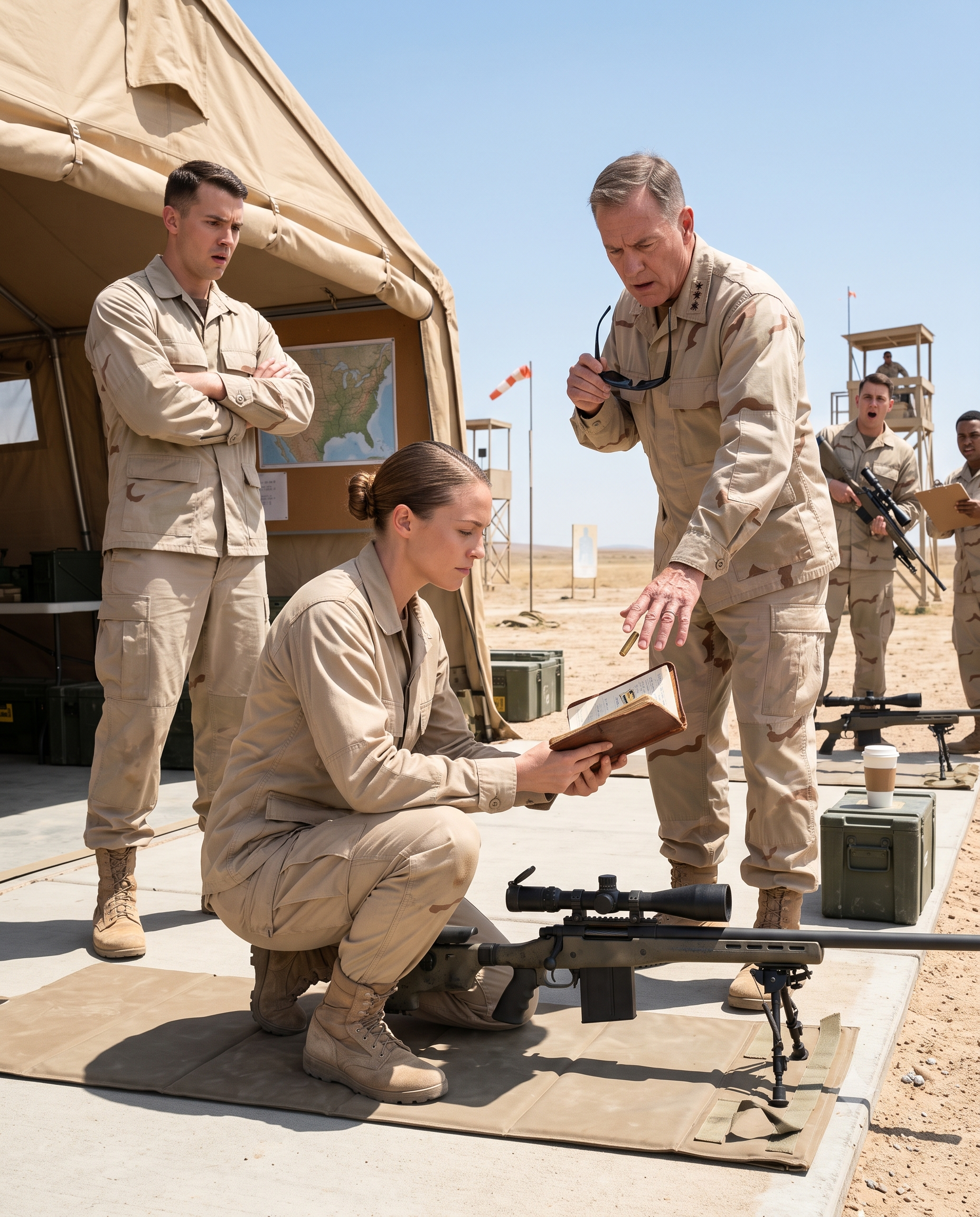
Beside the date was a call sign carved so small into the metal that most people would have mistaken it for damage.
I had not shown it to anyone in seven years.
Not because I was ashamed.
Because some rooms punish a woman for her past before they ever ask what it cost her.
The rifle on the mat was not mine. Newer. Heavier. Cleaner. Too proud of itself. I checked the bolt, the stock, the balance, then let my hand learn the trigger. Behind me, somebody muttered that we were wasting range time.
I heard him.
I also heard the high wind marker over the tower twitch first, while the marker down near the target moved half a second later.
The upper air was changing before the lower air did.
That was what thirteen men had missed.
Not courage.
Not skill.
Timing.
I opened the notebook to a page written in graphite so old the edges of the numbers had smeared into gray dust. General Harris stepped closer. His eyes dropped to the back flap.
Then his face changed.
The hardness went out of his jaw. He looked at the brass casing, then at me, then back at the call sign, like a door had opened in his memory that he had spent years holding shut.
Hale noticed.
His grin disappeared.
In front of me, the rifle waited.
Beyond it, the dry plain waited.
I took one breath, looked through the shimmer, and said the only sentence I needed.
“Then let the math talk.”
The page lay open in the white sun. General Harris’s hand hovered an inch above the scratched call sign, and in the silence, he whispered…
Part 2 below 👇👇
Part 2: “Ghostline.”
The word did not land loud.
It landed heavy.
Hale looked from the general to me, then down at the casing, trying to decide whether he had just heard a code name, a warning, or a ghost story he had no clearance to understand. General Harris did not take his eyes off the notebook. His fingers were still hovering above that old piece of brass like touching it might bring back every report that had gone missing seven years ago.
“You knew her?” one of the spotters asked.
Harris swallowed once. “I read the after-action file.”
That was when the men behind me stopped shifting their boots. A rifle range has its own kind of silence, but this was different. This was the sound of people realizing they had laughed too early.
Then a range tech came jogging from the tower with a tablet pressed to his chest. He was young, pale, and breathing hard enough that dust stuck to his lower lip.
“Sir,” he said to General Harris, “you need to see the wind telemetry from the upper sensor.”
Hale snapped, “Not now.”
The tech flinched but did not leave.
That was the new thing in the air.
Not my notebook.
Not Hale’s mouth.
Proof.
General Harris took the tablet. His face went still as he read the numbers, then the timestamp, then the correction pattern I had written by hand before the sensor ever caught it.
The spotter beside him sat back like his knees had forgotten their job.
Hale’s confidence drained out of his face one shade at a time.
I settled behind the rifle, cheek to stock, finger resting outside the trigger guard. The target swam in the heat four thousand meters away. I exhaled, waited for the upper wind to turn first, and said quietly, “Spotter, when I fire, call what you actually see.”
The general looked at Hale and said…
Part 3 and full ending: Type “PART 3” and Press “Like” so we can post the full story. Thank you!
If you don’t see it, switch to Newest/All.
Leave a Reply