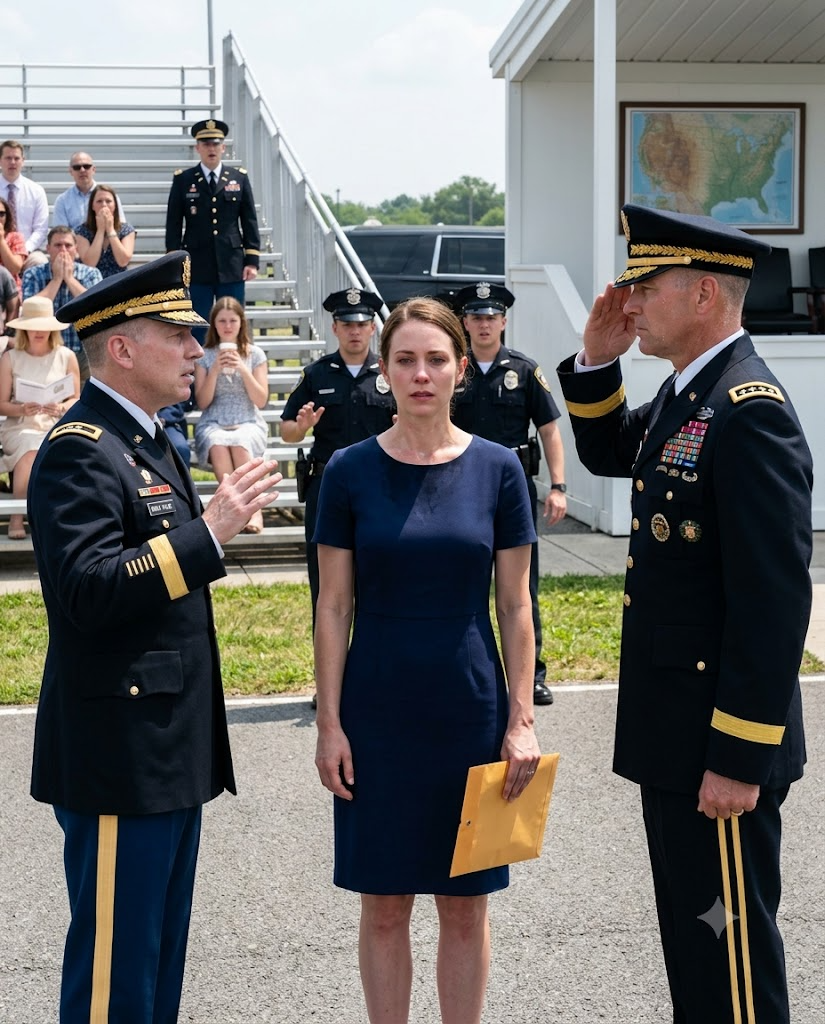
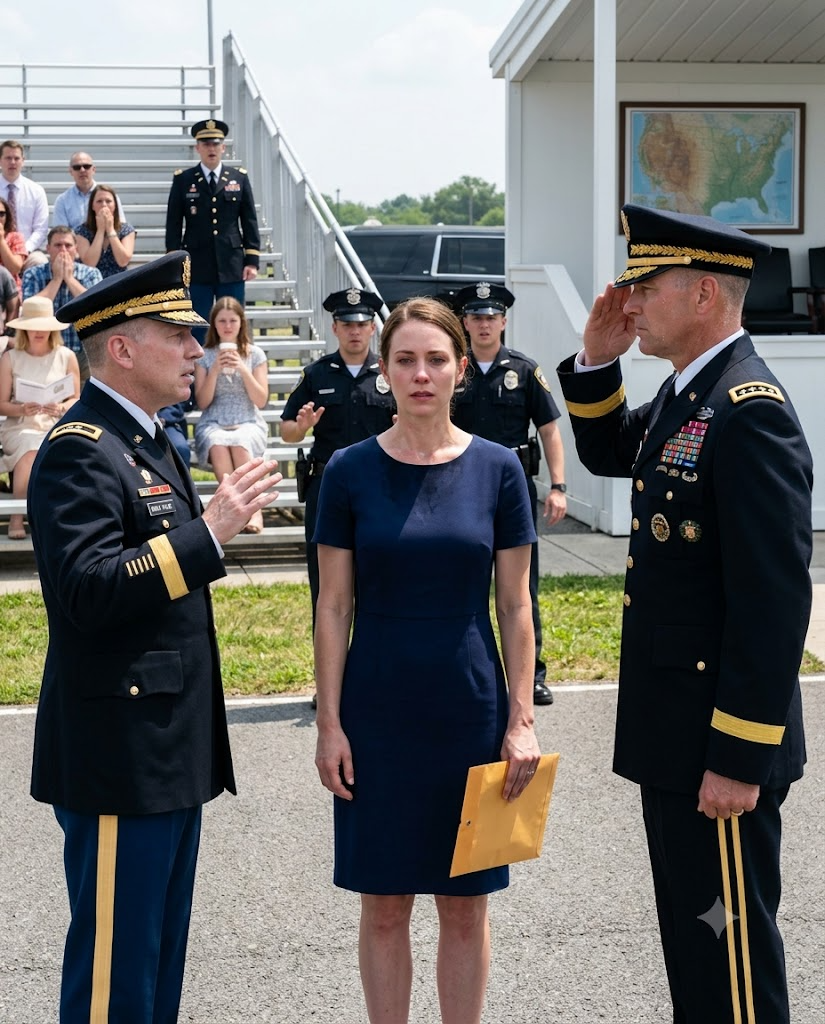
My Father-In-Law, A Brigadier General, Ordered Military Police To Drag Me Off The Parade Field In Front Of Hundreds… Until A Four-Star General Arrived, Looked At Me Once, And Whispered The Words That Turned The Whole Ceremony Ice Cold.
“This is Reaper Two.”
After that, nobody looked at me the same way again.
The military police closed in on me before the last notes of the national anthem had even faded over the parade field.
July heat shimmered above the asphalt. The air smelled like cut grass, sunscreen, pressed uniforms, and the sharp metal shine of medals catching the sun. Families froze halfway through clapping. Cadets stood stiff as fence posts. A little boy in the front row lowered his small hand-held banner and stared at me like he had just watched a celebration crack straight down the middle.
In the center of that silence stood my father-in-law, Brigadier General David Kline.
And he was pointing right at me.
“Remove this woman from the grounds,” he said, loud enough for the reviewing stand, the family bleachers, and every officer along the field to hear. “Now.”
For one second, nobody moved.
Not because they thought he was wrong.
Because on that base, David Kline’s voice carried the kind of weight that made people think about careers, promotions, assignments, and evaluations before they thought about basic human decency.
I stood there in a plain navy dress, sweat gathering beneath the collar, with a sealed envelope clenched in my hand. I had not opened it since 12:07.
My husband, Captain Daniel Kline, stood three rows behind me in full dress uniform. His jaw was locked so tight that the muscle near his ear kept jumping.
He did not step forward.
His mother stared at the flagpole.
His younger sister smiled into her paper coffee cup like humiliation was something best served cold.
“This woman has no clearance,” David continued. “She is not welcome here. And she is no longer part of my family.”
The first military policeman stepped toward me. Young. Nervous. Trying very hard not to show that his hands were not as steady as the order. His name tape read PARKER.
I saw the math happening in his eyes.
Senior officer. Public field. General watching. Woman in a navy dress who looked, to everyone around us, like the least dangerous person on the entire base.
I took the choice from him.
“Sergeant,” I said quietly, “I’ll walk if you ask me to. But today, I would strongly advise you not to put your hands on me.”
His face changed.
Not fear.
Recognition.
There is a tone military people hear right away. A calm voice trained past panic. A voice that does not rise because it learned a long time ago what happens when everyone else starts yelling.
David heard it too.
Unfortunately for him, he mistook control for weakness.
“Listen to her,” he said, turning just enough so the crowd could see him. “Six years of this nonsense. She marries my son and suddenly thinks she belongs anywhere near military business.”
A murmur moved through the bleachers. Programs rustled. Somewhere behind me, a metal folding chair scraped against concrete and stopped halfway, like even the chair knew better than to make noise.
“She was waiting tables when Daniel dragged her into a respectable life,” David added, and now he was smiling. “Now she walks around like she has any right to stand among people who actually served.”
I did not answer.
That was always what made him angriest.
To David Kline, I was Emily Reed-Kline, the woman he tolerated at Christmas, corrected at dinner, and introduced only when he had no way around it. He never asked where I disappeared during those long consulting contracts overseas. He never asked why certain people in secure offices returned my calls. He never asked why I always sat facing the door, counted exits, and woke up with my hand reaching for something that was no longer beside the bed.
Powerful men often confuse what they do not know with what does not exist.
To him, I was an embarrassment attached to his son’s last name.
What he did not know could have filled sealed archives.
That was when the black SUVs rolled slowly onto the base road beside the reviewing stand.
Quiet.
Clean.
Unhurried.
That is how people arrive when senior officers turn their heads before anyone explains who is inside.
My pulse slowed when I saw the small plate on the lead vehicle.
Four stars.
The band faltered on the transition. Conversations died row by row. Officers straightened as if an invisible cord had been pulled through every spine on the field.
David turned. Irritation flashed across his face, but he polished it away almost instantly into a service smile.
The back door of the SUV opened.
General Michael Shepherd stepped out.
Everyone on that parade field understood his rank in one second. Four stars. Command authority. The kind of reputation brigadier generals do not interrupt, correct, or make wait.
David moved toward him.
General Shepherd barely looked at him.
His eyes swept the crowd, past the reviewing stand, past the military police, past Daniel standing frozen in his row of dress uniforms.
Then his gaze stopped on me.
The change in his face was so sharp it seemed to pull the air out of the field. The color drained from his cheeks. His mouth parted, like he had forgotten the first word of a sentence he had carried for years. His eyes dropped to the sealed envelope in my hand, then rose again to my face.
The military police stepped back before anyone ordered them to.
Daniel’s expression cracked.
David’s smile began to die.
General Shepherd walked straight past my father-in-law and stopped inches in front of me.
The parade field went so still I heard the little paper banner snap in the child’s hand.
Then the four-star general raised his hand to his brow.
A full combat salute.
My father-in-law went pale.
And General Shepherd opened his mouth and whispered…
Part 2 below 👇👇
Part 2: “This is Reaper Two.”
The words did not travel far, but somehow everyone close enough to see General Shepherd’s face felt them land. Sergeant Parker’s hand fell from his belt. Daniel looked from me to the general like the woman he had slept beside for six years had vanished and someone else had been standing there all along.
David let out a short, embarrassed laugh.
“Sir, there must be some confusion,” he said. “This is my daughter-in-law. She has no standing here.”
General Shepherd did not turn around.
He kept his salute up until I gave the smallest nod.
Only then did he lower his hand.
“There is no confusion, General Kline,” he said, and the way he used David’s rank made it sound smaller than it had a minute earlier.
Then he looked at the sealed envelope in my hand.
I had kept my fingers steady through interrogations, evacuations, burning convoys, and rooms where one wrong breath could cost lives. But somehow, standing on that clean American parade field with a US map posted behind the reviewing stand and families staring from metal bleachers, I felt my thumb press too hard into the paper seam.
Daniel finally stepped forward.
“Emily,” he said, barely above a whisper. “What is he talking about?”
That was when General Shepherd’s aide came up behind him carrying a thin black folder with a red-bordered cover sheet clipped to the front.
Not a certificate.
Not a ceremony program.
An active personnel restriction notice.
Daniel saw the header first. His face emptied.
David saw the signature line next.
His knees did not buckle, but his pride did.
General Shepherd opened the folder, looked at my father-in-law, and said, “Before you give another order concerning this woman, you need to understand who authorized the envelope in her hand and why your name is already in the file…”
Part 3 and full ending: Type “PART 3” and Press “Like” so we can post the full story. Thank you!
If you don’t see it, switch to Newest/All.
Leave a Reply